Blog Posts

[vc_row][vc_column]
Vestibulum ante ipsum primis in faucibus orci luctus et ultrices posuere cubilia Curae; Lorem ipsum dolor sit amet, consectetur adipiscing elit. Donec dictum augue in pulvinar vestibulum.
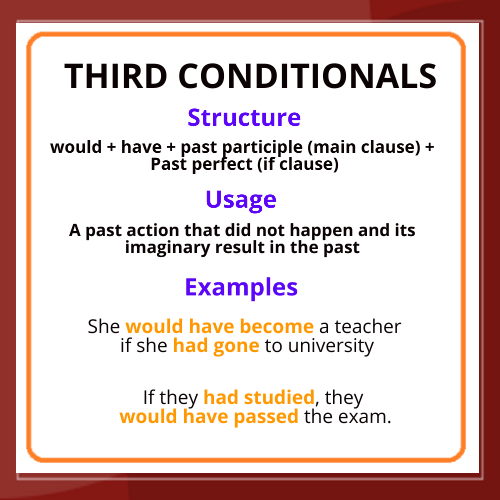
The Third Conditional is used to describe a past situation that did not happen and a past event that did not happen as a result. They can be used to express a missed opportunity.
The important thing about the third conditional is that both the condition and result are impossible now.
| If-clause | Main clause |
| If + past perfect | Would + have + past participle |
| If clause | Main clause |
| If + past perfect | Would + have + past participle |
| If I had won the lottery, | I would have bought a big yacht. |
| If I had had more time, | I would have cleaned my flat before I went on holiday. |
If he had studied, he would have passed the exam – He did not study and that is probably why he did not pass the exam.
If we had left home earlier, we would not have missed our train. – We did not leave earlier and because of this, we missed our train.
As with all conditional sentences, the order of the clauses can be changed. However, you may have to rearrange the pronouns and correct the punctuation.
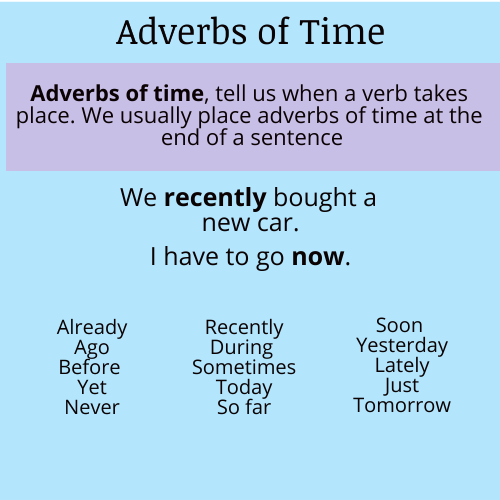
Adverbs of time, tell us when a verb takes place. We usually place adverbs of time at the end of a sentence. For example, I first met Paul last year. If you want to place more emphasis on the time then it can place at the start of the sentence – Last year was the best year of my life.
Already
Ago
Before
Yet
Never
Soon
Yesterday
Lately
Just
Always,
Recently
During
Sometimes
Usually
So far
Annually
Daily
Monthly
Tomorrow
Weekly
Yearly
I haven’t been going to play tennis lately.
We recently bought a new bike.
Lately, you’ve been very unpleasant to everyone at work.
They recently relocated to London.
The morning newspaper arrives daily.
Steven forgot his keys yesterday and again today.
I have to go now.
I first met Paul last year.
Last year was the best year of my life.
Tomorrow I will take my English exam
Yesterday my troubles seemed so far away
I have never heard this before.
I have not seen him since he left school..
I haven’t spoken to her yet.
She’ll be here soon.
I haven’t been feeling so well lately.
I’ve never been to Spain.
He left the office over an hour ago.
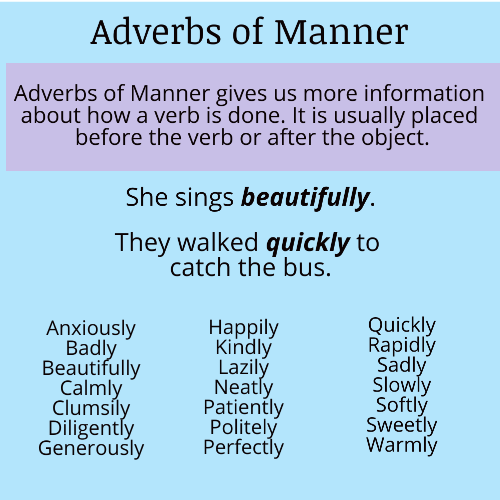
Adverbs of manner gives us more information about how a verb is done. Adverbs of manner are probably the most common types of adverbs that are used in English. For example – Kate sings beautifully.
Very often, adverbs of manner are adjectives with -ly added to the end, but this is not always the case. Some adverbs of manner will have the same spelling as the adjective form.
Slowly
Rapidly
Clumsily
Diligently
Sweetly
Warmly
Sadly
Calmly
Politely
Kindly
Lazily
Generously
Happily
Neatly
Patiently
Softly
Quickly
Beautifully
Badly
Anxiously
Notice how the adverbs are formed by adding -ly to the adjectives bad, correct and quick, although there is a slight spelling change when forming an adverb with the adjective easy – easily.
As mentioned, some adverbs of manner take the same spelling as the adjective and never add an -ly to the end:
My dad works hard. (not hardly)
Kate dances well. (not welly)
Kate passed the exam easily.
They walked quickly to catch the bus.
The birthday party went badly.
Simon answered all the questions correctly.
My mother trimmed the red roses neatly.
I combed my daughters hair carefully because it had lots of tangles.
Please don’t shout at me. Why can’t you talk to me calmly?
Could you please speak more slowly please.
She sings beautifully.
We waited anxiously at the hospital
This will close in 20 seconds